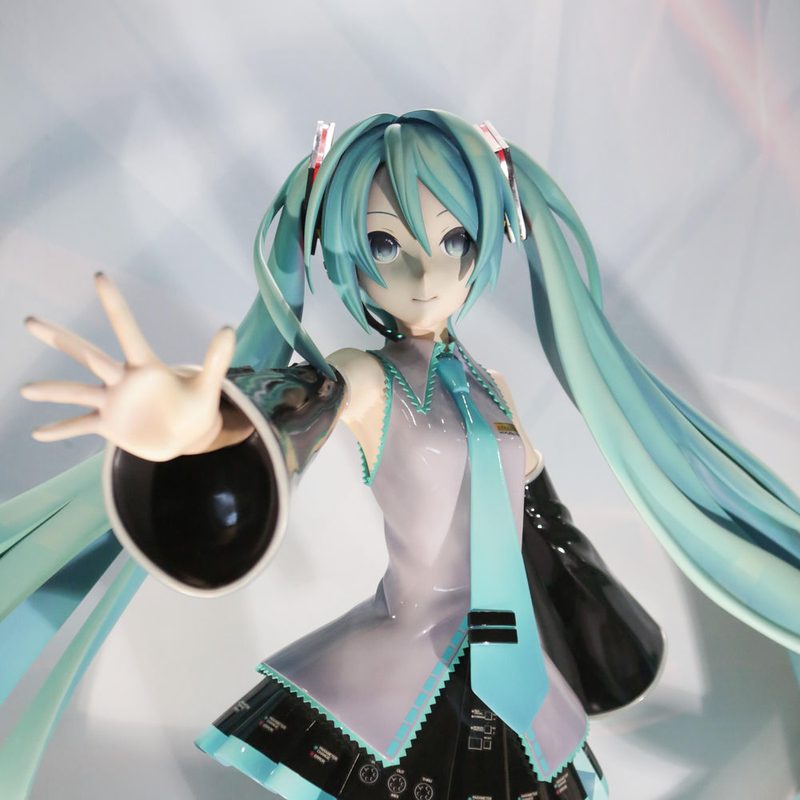
Hatsune Miku (Japanese: 初音ミク, [hatsɯ̥ne miꜜkɯ]), officially code-named CV01, is a Vocaloid voicebank and software application developed by Crypton Future Media. Her voice is generated using vocal sound samples provided by Japanese voice actress Saki Fujita. The software is personified by an official mascot character depicted as a 16-year-old girl with turquoise twintails. Marketed as a virtual idol, Miku has performed at live virtual concerts as an animated projection. Released in August 2007, Hatsune Miku was the second product built on Yamaha Corporation's Vocaloid 2 engine and the first Japanese voicebank for the platform. Subsequent updates have expanded her functionality across Vocaloid 3, Vocaloid 4, and Vocaloid 6 technology, alongside Crypton's proprietary Piapro Studio editor. The name of the character comes from merging the Japanese words for first (初, hatsu), sound (音, ne), and future (ミク, miku), thus meaning "the first sound of the future", which, along with her code name, refers to her position as the first of Crypton's "Character Vocal Series" (abbreviated "CV Series"), preceding Kagamine Rin/Len (code-named CV02) and Megurine Luka (code-named CV03). The number 01 can be seen on her left shoulder in official artwork.
Top Tracks
Credited On
- Hatsune Miku - Hatsune Miku Live Party 2013 in Kansai - Hatsune Miku, released August 30, 2013 (
MKPB-2002-1). Artist. - Hatsune Miku - Magical Mirai 2014 in Osaka - Hatsune Miku, released March 11, 2015 (
ANSX-11091). Artist. - Hatsune Miku - Magical Mirai - Hatsune Miku, released March 2, 2021 (
DL-6509). Artist. - Hatsune Miku - Miku Symphony 2025 Orchestra Live - Hatsune Miku, released February 4, 2026 (
WPXL-90354). Artist, MC.
Biography
From the en.wikipedia article Hatsune Miku (CC BY-SA 4.0), revision 1377030411.
Featured Music
In August 2010, over 22,000 original songs had been written under the name Hatsune Miku. In 2011, it was reported that she had 100,000 songs to her name. One of the Vocaloid compilations, Exit Tunes Presents Vocalogenesis feat. Hatsune Miku, debuted at number one on the Japanese weekly Oricon album charts dated May 31, 2010, becoming the first Vocaloid album to top the charts. Another album, Supercell, by the group Supercell, also features a number of songs using Vocaloids. Other albums, such as 19's Sound Factory's First Sound Story and Livetune's Re:package, and Re:Mikus also feature Miku's voice. Other uses of Miku include the albums Sakura no Ame (桜ノ雨) by Absorb, Miku no Kanzume (みくのかんづめ) by OSTER-project, and Unhappy Refrain (アンハッピーリフレイン) by Wowaka. The viral Nyan Cat meme featured an Utau cover of "Nyanyanyanyanyanyanya!" by Daniwell-P, the original song featuring Miku. Hatsune Miku first featured in a "live" virtual concert during Animelo Summer Live at the Saitama Super Arena on August 22, 2009, where a video of her singing two songs was projected. Miku made her first overseas live appearance at a concert on November 21, 2009, during Anime Festival Asia (AFA) in Singapore. Her first solo "live" performance titled "Miku no Hi Kanshasai 39's Giving Day" was held at Zepp Tokyo in Odaiba, Tokyo. Miku performed in the United States on July 2, 2011, at the Nokia Theater at L.A. Live during the 2011 Anime Expo in Los Angeles. The concert followed the same format as the previous "39's Giving Day" concert. She has continued performing since then, with tours in Asia, North America, Europe, and Oceania. A young male prototype used for the "Project If..." series was used in Sound Horizon's musical work "Ido e Itaru Mori e Itaru Ido", labeled as the "prologue maxi". The prototype sang alongside Miku for their music and is known only by the name "Junger März_Prototype β". Hatsune Miku was the opening act for Lady Gaga's world tour ArtRave: The Artpop Ball, performing throughout the first month of Gaga's tour from May 6 to June 3, 2014. In March 2014, Hatsune Miku and Crypton Future Media collaborated with Japanese rock band Bump of Chicken on the song "Ray". The accompanying music video featured the band performing alongside a live projection of Miku in real time without post-production composite editing. Pharrell Williams produced a remix of Livetune's song "Last Night, Goodnight" featuring Hatsune Miku. On October 8, 2014, Miku debuted on American network television performing "Sharing the World" on the Late Show with David Letterman on CBS. Hatsune Miku is featured in "B Who I Want 2 B" produced by Sophie from Namie Amuro's album Genic. The 2016 Hatsune Miku Expo tour featured American electronic band Anamanaguchi as an opening act; to commemorate the tour, the band recorded a single track titled "Miku", which they performed live on the tour with Miku as an encore song. Big Boi (of Outkast) sampled Aura Qualic's song "DATA 2.0", featuring Hatsune Miku for his 2017 single "Kill Jill", also appearing in the song's music video. Slushii collaborated with Hatsune Miku on the song "Through the Night", released on May 11, 2018. In January 2020, Hatsune Miku was announced as a performer at the Coachella festival in Indio, California, which was later canceled due to the COVID-19 pandemic. On December 11, 2020, Hatsune Miku was a featured artist on a remixed version of American rapper Ashnikko's song "Daisy" titled "Daisy 2.0". In January 2024, she was once again announced as a performer at Coachella. In 2022, American rock band Set It Off featured Hatsune Miku in their single "Why Do I", which replaces some of the vocals from their song of the same name from their Elsewhere album with Hatsune Miku. In 2026, Hatsune Miku featured as the vocals of "Cutie Mew Mew Magic", a track in the Deltarune soundtrack for Chapter 5 arranged by Camellia.
Sources
- Wikidata entity Q552682.
- en.wikipedia, Hatsune Miku (revision 1377030411), CC BY-SA 4.0.
- ja.wikipedia, 初音ミク (revision 111134890), CC BY-SA 4.0.
- Photograph: Hatsune Miku.jpg - Press shot via Deezer (artist 5090269).