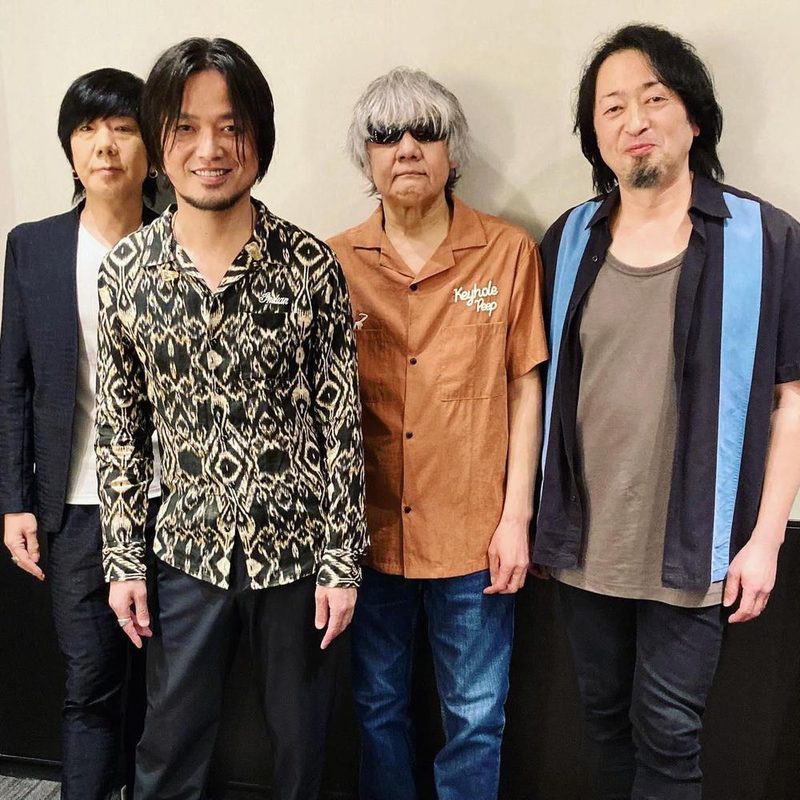
The Pillows (Japanese: ザ・ピロウズ, Hepburn: Za Pirōzu) were a Japanese alternative rock band formed in Hokkaido in 1989. Originally a quartet, vocalist and rhythm guitarist Sawao Yamanaka, lead guitarist Yoshiaki Manabe and drummer Shinichiro Sato continued the band as a trio for another 33 years, following the departure of bassist Kenji Ueda in 1992. They are best known in the West for providing the soundtrack for the anime series FLCL. The Pillows announced their disbandment at the end of January 2025, and Sato died from cancer in March 2026.
Top Tracks
Releases in the Catalogue
- The Pillows - Wake up! Stand up! and Go! -
AVBD-91501(2008)
Members
Current
- Sawao Yamanaka - Guitar, Vocal
- Yoshiaki Manabe - Guitar
- Yoshinori Arie
Former
- Jun Suzuki - Bass [Guest]
- Shinichiro Sato - Drums
- Kenji Ueda
- Tatsuya Kashima
History
Translated from the ja.wikipedia article The pillows (CC BY-SA 4.0), revision 110347528.
History
Based on changes in the band’s lineup and musical style, the pillows can be divided into a first period (1989–1993), second period (1994–1996), third period (1996–2012), and fourth (“late”) period (2013–2025).
First Period
The first period refers to the time from the band's formation on September 16, 1989, until the departure of its first leader, bassist Kenji Ueda, in 1993. Ueda held the initiative within the band, and the members' abilities were still developing during this period.
Dissolution of KENZI & THE TRIPS
Following the breakup of KENZI & THE TRIPS, bassist Kenji Ueda conceived of forming a new band with Sawao Yamanaka, the former vocalist of Coin Locker Babies. He subsequently invited KENZI & THE TRIPS drummer Shinichiro Sato and added guitarist Yoshiaki Manabe, formerly of Persha, and the pillows was formed on September 16, 1989. The name the pillows was derived from the Cherry Red Records compilation album Pillows & Prayers, which happened to be on a record shelf when the members gathered at Manabe's home at the time of the band's formation. Sawao Yamanaka stated of the band's name, “Because I am a songwriter who writes a variety of songs, I wanted the band name not to specify a genre.” The word “pillow,” meaning “makura” (枕) in Japanese, is often used as a term representing the band, while the number “916,” representing its formation date of September 16, is also sometimes used in the designs of merchandise and other items.
The pillows had originally intended to debut as a three-piece band consisting of vocalist and guitarist Yamanaka, bassist Ueda, and drummer Sato. However, according to Yamanaka himself, “My guitar playing was so poor that the other two were at a loss,” and the band urgently decided to audition guitarists. Manabe later joined after being introduced by Naosumi Masuko of Dohatsuten.
The pillows began activities as an independent band and released two mini-albums through Captain Records. In 1991, they made their major-label debut through Pony Canyon with the single “Ame ni Utaeba,” and released two singles and two albums.
The music of the first-period the pillows had no clearly defined genre or direction. According to the members themselves, their only vague shared understanding was that they wanted to “play good songs like The Beatles.”
Although the first-period the pillows pursued band activities energetically, aided by the recognition of KENZI & THE TRIPS as a popular punk rock band, differences in musical initiative within the group gradually deepened, leading leader Ueda to leave in 1993. The first-period the pillows had two composers, Kenji Ueda and Sawao Yamanaka, but an increasingly irreversible divergence had emerged between their respective musical aims and visions for the band. Having lost its leader, the pillows largely suspended public band activities for approximately one year, compounded by a change of record company.
Second Period
The second period refers to the period from 1994, when vocalist Yamanaka became the leader following Ueda's departure and the band resumed full-scale activities, until 1996, when the failure of “Tiny Boat” prompted a shift in its direction. It was a period in which the band sought a new form of the pillows without Ueda, and served as a transition toward the third period.
After Ueda's departure, the pillows' public band activities had effectively been suspended for approximately one year. The band then resumed full-scale activities with Yamanaka as its new leader and Tatsuya Kashima of SUPER BAD as a support bassist. However, Yamanaka was unable to reconcile himself with the songwriting method of a certain prominent producer who had been brought in as a measure to overcome poor sales. This was not because he disliked the producer personally; while acknowledging that such a method existed, he could not accept it. When he rejected the arrangement on the first day of recording, the band's contract with Pony Canyon was terminated. The group subsequently moved to King Records, which had appreciated its songs, and Jin Yoshida of SALON MUSIC joined as producer through an introduction by Tatsuya Kashima, substantially changing the band's character. During the second period, the band released three singles and two albums.
The music of the second-period the pillows was characterized by diverse rhythmic approaches and a stylish sound, resulting from newly appointed leader Yamanaka's incorporation of soul music and bossa nova-style elements. While aiming for pop melodies, the band produced many songs with elaborate arrangements.
As Yamanaka described it as “a period when we were very conscious of becoming successful,” the second-period the pillows actively adopted outside opinions and pursued commercial strategies such as tie-ins. However, the band was unable to achieve the level of commercial success it had hoped for, and gradually came to struggle with the gap between the ideas of those around it and the music it wanted to make. The members were particularly disappointed when sales of their fifth single, “Tiny Boat,” released in January 1996, proved sluggish. This became the catalyst for the pillows' transition into its third period.
Third Period
The third period refers to the period from the release of “Strange Chameleon” in June 1996 until the band’s temporary hiatus in 2012. It was a period in which the pillows pursued styles such as rock and alternative rock, gradually expanded their support base, and established their current image; it is also said that many of their current listeners discovered the pillows during this time.
The sixth single, “Strange Chameleon,” compared the members, who had aimed to create popular music but failed, to “defective chameleons that do not blend in with the colors around them,” and constituted a major rejection of the music and style the pillows had developed up to that point. As a result, the release of “Strange Chameleon” was carried out in a semi-forced manner amid conflict between the members and their record company, which opposed it. The fifth album, Please Mr. Lostman, which included “Strange Chameleon,” was described by the members as a “will to the music industry,” made with the possibility of retreating to the independent scene in mind. At the same time, it was an album expressing their determination to stubbornly pursue the music they believed in under any circumstances.
Having thus dramatically changed the band’s direction, the pillows gradually began to gain support, with “Strange Chameleon” receiving heavy rotation on FM radio stations. The bonds between the members and staff, who had overcome adversity together, also reportedly became stronger. As Yamanaka stated that on the subsequent sixth album, LITTLE BUSTERS, he “faced the listeners for the first time” and sang of his “feelings of gratitude toward the people who understood us in front of us,” the circumstances surrounding the pillows gradually improved following the change in their approach.
Thereafter, the pillows established their present style as a rock band through the alternative approach. Around this time, Jun Suzuki of THE CHEWINGGUM WEEKEND replaced Tatsuya Kashima as the band’s support bassist.
Alongside the production of original albums, the third-period pillows began releasing best-of albums and B-side collections, developing their music in a variety of ways. In 2004, they released a self-cover album and a tribute album to commemorate the 15th anniversary of their debut. At the end of 2006, they moved to avex trax, and in 2007 released a singles collection covering the songs included on singles issued during their time with King Records. They also became active in releasing video works such as DVDs and publications such as band scores.
From the 2000s onward, they also performed outside Japan in response to the voices of many fans. Beginning with their 2005 American tour, they repeatedly held overseas performances and tours with success. The popularity of the pillows outside Japan, particularly in the United States, was reportedly high enough to surprise the members themselves. Much of this high overseas acclaim was gained alongside the overseas popularity of the Gainax-produced OVA FLCL (フリクリ), for which the pillows provided theme songs and insert songs. FLCL was broadcast from 2000 to 2001, and more than 20 songs by the pillows were used across its six episodes.
In 2009, the band marked its 20th anniversary with a series titled “LATE BLOOMER SERIES,” which included the release of two best-of albums, numerous tours, a worldwide cover contest using the video-sharing website YouTube, and their first solo concert at Nippon Budokan. The following month, they released their 16th album, OOPARTS.
In July 2012, they announced through their official website and fan club newsletter that they would temporarily suspend activities as the pillows for “band maintenance and rehabilitation.” To avoid confusion with a hiatus “close to a breakup,” Yamanaka referred to it as a “break.” During this period, Yamanaka released his third solo album, Hakai-teki Innovation, and held his first solo concert. Manabe also released his first guitar solo album, Rutile.
Fourth Period (Final Period)
In June 2013, it was announced that the pillows would resume activities.
In 2014, as part of the 25th-anniversary project “NEVER ENDING STORY,” the band held a concert at Shinjuku Loft featuring songs from its first period, with former leader and original bassist Kenji Ueda joining them. A second tribute album was released, followed by a tour of joint performances with the participating bands, and concerts in Tokyo, Nagoya, and Osaka centered on songs from the second period. On October 4, the anniversary concert “DON'T FORGET TODAY” was held at Tokyo Dome City Hall, and the 19th album, Moon Dust, was released that month. In an interview upon the album’s release, Yamanaka declared that the band had entered its “final period” following the resumption of activities in 2013. Although there was not as great a gap in sound as there had been between the first and second periods and the third period, Yamanaka described the fourth period’s musical style as having “sealed away alternative.”
In March 2015, longtime support musician Jun Suzuki left after the final date of the Moon Dust tour due to years of poor conduct.
In April 2016, the 20th album, STROLL AND ROLL, was released. It was produced with five bassists associated with the band: Kenji Ueda, JIRO of GLAY, Tomoyuki Miyagawa of HiGE, Tatsuya Kashima, and Yoshinori Arie. Beginning with this album, the band moved to DELICIOUS LABEL, headed by Yamanaka, while album distribution effectively returned to its former label, King Records.
In March 2017, the 21st album, NOOK IN THE BRAIN, which marked a return to alternative rock, was released. From November to December of that year, live concerts recreating every song from the albums Please Mr. Lostman and LITTLE BUSTERS were held as “RETURN TO THIRD MOVEMENT! Vol.1.” At the same time, the band’s first vinyl editions of the two albums were released.
In May 2018, “RETURN TO THIRD MOVEMENT! Vol.2” featured live recreations of every song from the albums RUNNERS HIGH and HAPPY BIVOUAC, while vinyl editions of both albums were also released. In September, the 22nd album, REBROADCAST, was released, and the “REBROADCAST TOUR” was held from November of that year through March of the following year. The band also contributed two newly written songs to the sequel to the animated film FLCL, released that year, and issued the album FooL on CooL generation through Toho. In addition to the new songs, it included 12 older songs, all of which were re-recorded.
In September 2018, the 30th-anniversary project titled “Thank you, my highlight” began. In addition to albums and tours, a documentary about the band’s American tour and the non-documentary theatrical film Ousama ni Nare (王様になれ) were produced; the latter was released in September 2019. On October 17, 2019, the 30th-anniversary concert “LOSTMAN GO TO YOKOHAMA ARENA” was held at Yokohama Arena.
During the series of 30th-anniversary projects, Yamanaka stated in interviews that “the pillows are going on a long vacation.” No new releases followed the single Happy Go Ducky!, released on October 9, 2019. From 2021, the band actively staged the third installment of the aforementioned “RETURN TO THIRD MOVEMENT!” tour, followed by the fourth installment in 2022.
On September 16, 2024, the 35th-anniversary concert “ABOUT A ROCK’NROLL BAND” was held at Toyosu PIT. On November 2 of the same year, the limited EP Blank, featuring the band’s first new songs in five years, was released, and the “LOSTMAN GO TO CITY 2024-25” live tour began that same day.
On February 1, 2025, the band announced that it had ended activities as a three-piece and disbanded following the KT Zepp Yokohama performance of “LOSTMAN GO TO CITY 2024-25” on January 31. That concert effectively became its final live performance.
Members
For the individual activities of each member, see their respective articles.
Members at the Time of Disbandment
Sawao Yamanaka (やまなか さわお) Vocals and guitar. The leader of the pillows, he was responsible for writing and composing nearly all of the band's songs, as well as designing tour merchandise.
Yoshiaki Manabe (まなべ よしあき) Guitar. He also participated in mixing during recording sessions.
Shinichiro Sato (さとう しんいちろう) Drums. He died of esophageal cancer on March 23, 2026, at the age of 61.
Former Members
Kenji Ueda (うえだ けんじ) Bass guitarist. He was a member from the band’s formation until 1993 and served as its leader until his departure.
Support Members at the Time of Disbandment
Tomoyuki Miyakawa (宮川トモユキ) Bass. A member of HiGE.
Takumaru Anzai (安西卓丸) Bass. Formerly of Fukurozu.
Former Support Members
Tatsuya Kashima (鹿島達也; born August 20, 1962) Formerly of SUPER BAD and Tetsu 100%. Bassist. Participated from 1994 to 1999 and in 2015. Born in Tokyo.
Jun Suzuki (鈴木淳) Bassist. Formerly of THE CHEWINGGUM WEEKEND. Participated from 1999 to 2015. Nicknamed Jun.
Yoshinori Arie (有江嘉典) Bassist. A member of VOLA & THE ORIENTAL MACHINE. Participated from 2015 to 2024.
Sources
- Wikidata entity Q615120.
- en.wikipedia, The Pillows (revision 1368872484), CC BY-SA 4.0.
- ja.wikipedia, The pillows (revision 110347528), CC BY-SA 4.0.
- Photograph: The Pillows.jpg - Press shot via Deezer (artist 1178).