
Nippon Columbia Co., Ltd. (日本コロムビア株式会社, Nippon Koromubia Kabushiki Gaisha), often pronounced Korombia, operating internationally as Nipponophone Co., Ltd. (日本蓄音器商会, Nihon Chikuonki Shōkai), is a Japanese record label founded in 1910 as Nipponophone Co., Ltd. It affiliated itself with the Columbia Graphophone Company of the United Kingdom and adopted the standard UK Columbia trademarks (the "Magic Notes") in 1931. The company changed its name to Nippon Columbia Co., Ltd. in 1946. It used the Nippon Columbia name until October 1, 2002, when it became Columbia Music Entertainment, Inc. (コロムビアミュージックエンタテインメント株式会社, Koromubia Myūjikku Entateinmento Kabushiki kaisha). On October 1, 2010, the company returned to its current name. Outside Japan, the company operated formerly as the Savoy Label Group, which releases recordings on the SLG, Savoy Jazz, and continues to operate as Denon. It also manufactured electronic products under the Denon brand name until 2001. In 2017, Concord Music acquired Savoy Label Group. Nippon Columbia also licensed Hanna-Barbera properties in Japan until those rights were transferred to Turner Home Entertainment sometime in 1997. Currently, these rights are owned by Warner Bros. Japan LLC.
On This Label
Released or manufactured by Nippon Columbia, from this catalogue:
- Malice Mizer - merveilles l'espace - Malice Mizer, released March 30, 2002 (
COBA-4162), from the Tour ’98 merveilles ~終焉と帰趨~. Distributed By, Manufactured By, Releasing Label.
Gallery
History
Translated from the ja.wikipedia article 日本コロムビア (CC BY-SA 4.0), revision 110797235.
Pre-War Period
In October 1907, Takeichiro Matsumoto founded Nichibei Chikuonki Seizo to produce and sell domestically manufactured disc records. On October 1, 1910, it was incorporated as Nippon Chikuonki Shokai in Kawasaki Town, Tachibana District, Kanagawa Prefecture (now Kawasaki Ward, Kawasaki City). It is Japan's longest-established record company. During the Taisho period, it acquired Toyo Chikuonki, Teikoku Chikuonki Shokai, Sankodo, and Tokyo Chikuonki.
From 1927, it maintained a partnership with the American Columbia Records company (now Sony Music Entertainment). In addition to recorded content, this involved the import and export of record discs and phonograph technologies. In 1928, it was renamed Nippon Columbia.
During the war, it was renamed Nitchiku Kogyo, but reverted to Nippon Columbia in 1946. Until the 1960s, RCA Victor (formerly Victor Talking Machine) and Columbia Records, the two dominant American companies, competed in developing both record-disc technologies, including cutting and recording, and phonograph technologies for playback. Nippon Columbia was among the first to market Japanese music releases on LP records.
Postwar
After the war, the company focused primarily on the production and release of records of enka and kayokyoku, traditional performing arts, and school music teaching materials. From the mid-1960s, however, it also entered the fields of Group Sounds and anime songs for children's programs such as anime and tokusatsu productions, and from the mid-1970s, idol kayokyoku. Meanwhile, its partnership with Columbia Records in the United States ended on June 30, 1967. As of June 30 of the following year, the grace periods associated with its import and distribution rights and its right to use the CBS label, equivalent to a license, for certain Japanese recordings also expired. Consequently, its lineup of Western music, including rock bands and pop music, declined substantially, and it is now limited to a small number of releases centered on classical music and jazz performances produced in-house or for which it has acquired distribution rights. Since changing its corporate name to Columbia Music Entertainment in October 2002, it has placed greater emphasis on J-pop, which had been regarded as an unprofitable division since the mid-1990s.
During the Showa era, the company had numerous leading enka and kayokyoku performers under contract, including Hibari Misora, Sayuri Ishikawa, Chiyoko Shimakura, Harumi Miyako, Ichiro Fujiyama, and Kazuo Funaki, and enjoyed sufficient momentum to divide the market with Victor Music Industries, Toshiba EMI, and Teichiku Entertainment. In contrast to those record companies and emerging companies such as Sony Music, Pony Canyon, and Avex, its J-pop division was occupied by artists with relatively limited fan bases, including Godiego, Masatoshi Nakamura, Ikuo Sakakibara, Chiharu Matsuyama, and The Collectors, and, from the Heisei era onward, thee michelle gun elephant, Pizzicato Five, Kegawa no Maries, and 04 Limited Sazabys.
Nippon Denki Onkyo (日本電気音響; DENON), which became a subsidiary in 1947, began releasing component equipment under the Denon brand after its moving-coil cartridge, the DL-103, which had been developed and supplied for broadcasting stations in 1963, began to be distributed in the general audio market around 1964. Some modular stereos and mini component systems, as well as general audio products such as radio cassette recorders, portable record players, and home karaoke equipment, were also distributed under the Columbia brand. In 1960, the same year that regular color broadcasting began, it released a color television and also manufactured refrigerators, and for a time showed an orientation toward becoming a comprehensive home-appliance manufacturer. Around 1972, it carried out digital recording and released LP records using the world's first practical PCM digital recorder, the DENON DN023R, jointly developed with NHK's Science and Technology Research Laboratories, demonstrating its role as a manufacturer with both software and hardware operations. However, as part of the business restructuring measures described below, it was spun off as Denon, later Denon Consumer Marketing, in 2001. Following its subsequent management integration with Nippon Marantz, later Marantz Consumer Marketing, it has operated as an audio equipment manufacturer specializing in high-end products.
Heisei
Around 1992 (Heisei 4), the production and distribution of tokusatsu music under the ANIMEX label (formerly Brazil Records) and certain anime song works were spun off to Forte Music Enterprise Co., Ltd. (FME), with the director becoming independent. However, around 1996 (Heisei 8), the company became insolvent and was liquidated, resulting in Columbia acquiring its recordings.
Acquisition by Ripplewood
With the start of the Heisei period, sales continued to decline and the company gradually fell into financial difficulties. Unlike Avex, whose sales share expanded rapidly through the Komuro boom, Nippon Columbia lacked million-selling flagship artists. In addition, several prominent artists who had ranked on the Oricon charts at the time—THE YELLOW MONKEY, which later temporarily returned to its original label Columbia upon its reunion after transferring to Fun House and, as of 2022, was signed to Warner Music Japan; HOUND DOG, which transferred to R and C; and Alisa Mizuki, who transferred to avex tune—moved to other companies around 1997 at the wishes of their management agencies. The company was slow to discover replacement new artists in its J-pop division, which had been less aggressive than those of other companies. In its enka and kayokyoku division, it also failed to produce hit songs apart from Kiyoshi Hikawa, who debuted in 2000.
As part of a business reconstruction scheme, in May 2001, at the behest of Hitachi, Ltd. and its principal transaction banks, including Dai-Ichi Kangyo Bank and Sanwa Bank, management control was entrusted to the corporate turnaround fund Ripplewood (RH).
Around the same time, Heat Wave Co., Ltd. (HEAT WAVE), into which the J-pop division had been spun off in 1998, fell into excess liabilities in March 2001. It was liquidated and subsequently absorbed into Columbia. In August of the same year, the company sold the real estate of its headquarters building in Akasaka 4-chome, which also housed recording studios, and leased premises until its relocation to Roppongi.
On October 1 of that year, the audio equipment division was first spun off as Denon, a wholly owned subsidiary of Nippon Columbia. Nippon Columbia immediately raised 6 billion yen by selling its Denon shareholding to Ripplewood’s intermediate holding company, New Denon, which invested 5.9 billion yen for a 98% stake, and Hitachi, which invested 100 million yen for a 2% stake. On the same day, Nippon Columbia, following the business split, issued 92.308 million preferred shares at 65 yen each through a third-party allotment. Of these, 83% were allotted to the anonymous partnership investment fund Ripplewood Nippon Columbia Partners, in which Ripplewood invested 80% and Daiichikosho and Mitsubishi Corporation each invested 10%, and 13% were allotted to Hitachi. The investment fund became the largest shareholder, with a 41.66% stake overall. At this point, Hitachi’s shareholding ratio exceeded 20%, resulting in a capital structure led by foreign capital. In addition, common shares worth 4.1 billion yen were allotted to Hitachi in exchange for accumulated debt.
As a result of financing on the scale of 10 billion yen, the company’s financial condition was restored to health. As its share price was then trading at around 200 yen, Ripplewood had unrealized gains at that point if the preferred shares could be converted into common shares. In July 2002, capital was further strengthened through the issuance of 6.8 billion yen in common shares, with Ripplewood as the principal subscriber.
Ripplewood continued to hold shares in D&M Holdings, established in 2002 through a share transfer and management integration between Denon and Nippon Marantz. When it sold those shares to Bain Capital in 2008, it obtained a substantial capital gain of 12.6 billion yen.
Results of Management Reform and Declining Performance
Under RH's measures, Strauss Zelnick, who had served as chairman of BMG Entertainment in the United States, was selected to become representative director and chairman. Katsumi Matsumura (Jack Matsumura), a former member of Sadistic Mika Band who had served as a producer at Sony Music and vice president of BMG Funhouse, now Sony Music Labels, and Masao Nakajima, who had worked as a producer at Being, were invited to join the board as directors. A new structure was established under which Matsumura became representative director and CEO on October 1, 2001, when management control was transferred to RH.
The company was thereafter said to be embarking in earnest on artist development in its J-pop division. However, Matsumura died suddenly of heart failure in August 2002 at the age of 48, and Nakajima succeeded him as CEO. In October 2002, the company changed its name from Nippon Columbia, which had been familiar for 55 years, to Columbia Music Entertainment.
At the end of October of the same year, Hitoto You's debut release, “Morainaki”, recorded long-running sales and entered the top five of the Oricon charts. Thereafter, sales gradually increased through measures including Kaela Kimura's debut in 2003; steady sales of works by established artists such as Kiyoshi Hikawa; the release of best-of albums in the enka and anime song fields; and the successive DVD releases of older animated works by Mushi Production and the Kids' War series of daytime dramas produced by Chubu-Nippon Broadcasting.
By 2005, the company sold three subsidiaries—Columbia Acoustic Industries, Eggman Co., Ltd., which operated Shibuya eggman and had been positioned as the live music venue business of the former Nippon Columbia, and Columbia Digital Media—to Pine Ridge Co., Ltd., a corporate buyout fund operator. Even after the sale, they continued to constitute the employers of the Columbia Health Insurance Society and were therefore grouped together as the former Nippon Columbia Group.
From 2007, while the company was still undergoing reconstruction, the share of music distribution rapidly expanded throughout the record company industry, while sales of CD media declined. Columbia was also affected, and its sales once again fell. In response, it carried out major restructuring measures, including soliciting voluntary retirement from several hundred employees, including those in production departments, and allowing contracts with poorly selling artists to expire without renewal.
In 2007, the company acquired TDK Core, a TDK subsidiary engaged primarily in the production and sale of video software, for 1.5 billion yen. In 2008, it changed the company's name to Creative Core. Although its video software operations were integrated, this did not lead to dramatic business expansion.
Its share price also gradually declined from around 100 yen beginning in 2008. On February 22, 2009, when falling stock prices were becoming more pronounced across the market because of the global financial crisis, it reached a year-to-date low of 16 yen. Although it subsequently recovered to the 40-yen range because the results for the fiscal year ended March 2009 were not pessimistic, a going-concern assumption was noted in the financial statements, and difficult management conditions continued, with the share price remaining at the low level of 25 to 30 yen from September 2009 onward.
Efforts Regarding Corporate Pensions
In connection with the issue of underfunded defined-benefit corporate pension plans raised during the restructuring of Japan Airlines in 2009, the morning edition of the Nikkei newspaper of December 9, 2009, on page 9 in the corporate section, reported that Columbia's pension benefit obligation shortfall was approximately 4.1 billion yen and that, when divided by its shareholders' equity of approximately 800 million yen, the shortfall ratio was 489%, the worst among listed companies. During this period, the company negotiated reductions in benefit payments with former employees and obtained the consent of the majority, as reported in an article dated December 11 of the same month. The case was also described in detail in a feature article in the March 22, 2010 issue of Nikkei Business as an example in which an agreement to reduce corporate pension benefit payments was reached.
Acquisition by Faith
In January 2010, Faith, a content distribution service company, announced that it would acquire a total of 31.39% of the issued shares of Columbia Music Entertainment from Ripplewood Nippon Columbia Partners, established by RHJ International, which had been the largest shareholder and held management control since October 2001. As a result, Faith became Columbia's largest shareholder, and Columbia joined the Faith Group as an equity-method affiliate.
Consequently, all incumbent directors, including the CEO, resigned. The replacement of the management team with executives dispatched from the Faith Group was approved at an extraordinary general meeting of shareholders on April 6 of that year and at the regular general meeting of shareholders in June. Faith founder Hajime Hirasawa became chairman of the board, while Yasuharu Hara, formerly a vice president and a longtime sales executive who had risen through the ranks at the former Nippon Columbia, became president, representative executive officer, and COO. Almost all outside directors and outside corporate auditors concurrently held positions as Faith executives.
Meanwhile, filings of amended large shareholding reports under the 5% rule with EDINET revealed that Hitachi had gradually sold its Columbia shares from September 2009 and from February 2010 onward.
In March 2014, following a tender offer, Faith increased its ownership stake to more than 50%, making Columbia its subsidiary.
In August 2017, Faith made Columbia a wholly owned subsidiary through a share exchange. On February 1, 2021, Columbia relocated its head office to Faith's Tokyo office.
Return to the Columbia Name
In May 2010, it was announced that the company would change its name back to Nippon Columbia Co., Ltd. (日本コロムビア, third incarnation; English: NIPPON COLUMBIA CO., LTD.) on October 1 of the same year, the date of its 100th anniversary. This was the first return to its former name in eight years, since it had changed its name to Columbia Music Entertainment on October 1, 2002. The name change was carried out as scheduled on October 1 of that year. Although the corporate emblem after the name change revived the former emblem, its symbolic color remained the navy blue used during the CME era rather than the black used until September 2002.
The reasons for the change included the transfer of the largest shareholder (controlling shareholder) from a foreign investment fund to a domestic company for the first time in approximately ten years, and the expansion of the group's principal business from music and video software to video- and game-related fields. The current management therefore determined that including “Music” in the company name no longer reflected its actual circumstances.
Under the Nippon Columbia Group
On October 1, 2025, Faith established Nippon Columbia Group Co., Ltd. (日本コロムビアグループ), alongside its existing music business, with the aim of making artificial intelligence (AI)-based businesses its core operations. The company, Dreamusic, and others were placed under the group. The group will be responsible for establishing an integrated system using AI for artist production, rights management, and distribution, as well as promoting rights and ethics concerning generated content, including copyright. As a result, the company became distinguishable from Columbia Records, an in-house record label of Sony Music Entertainment in the United States.
On April 1, 2026, the company relocated its headquarters to Jingumae M-SQUARE.
Pressing Facilities
From its founding until the mid-2000s, Nippon Columbia was one of the few record companies to own a large-scale pressing plant for various disc media, including records, CDs, and DVDs: the Kawasaki Plant, located in Minatocho, Kawasaki-ku, Kawasaki, Kanagawa Prefecture. Other such companies included SMEJ, Victor Entertainment, Toshiba EMI, later TOEMI Media and then Memory-Tech, and Teichiku, which later withdrew from the pressing business. In 2005, after establishing Columbia Digital Media (CDM) as a subsidiary for the pressing plant, the land was sold to Harakosan Co., Ltd. of Shimonoseki, while the buildings were sold to Pine Ridge Co., Ltd., a corporate acquisition fund.
Production continued thereafter, but around July 2007, the company relocated its base from Kawasaki Minatocho to the grounds of the Sony DADC Japan Shizuoka Plant Oigawa (DADJ-O), now the Sony Music Solutions Oigawa Production Center, located alongside the Tomei Expressway in Yaizu, Shizuoka Prefecture. Although the company changed its name to CDM Partners, it went bankrupt in 2009 following a bankruptcy petition filed by its employees.
The former Kawasaki Plant site was redeveloped by Keihin Electric Express Railway and Daiwa House Industry into the large-scale condominium complex Rivarie, provisionally known during construction as the Kawasaki Minatocho Project.
Minatocho Station on the Keikyu Daishi Line, the station nearest to the Kawasaki Plant, was called Columbia-mae Station from its opening in 1932, when it was upgraded from a temporary stop, until 1944. In connection with this history, on March 1, 2013, an area tracing the history of the Kawasaki Plant was established within Minatocho Station, and Misora Hibari's signature song “Minatomachi Juusanchoume” was adopted as the station's departure melody. A song monument for the same song was also installed in the station.
As of 2021, the production of Nippon Columbia's various packaged media, excluding music tapes, was outsourced to Sony Music Solutions, Memory-Tech, for classical, jazz, UHQCD, and similar products, and JVC Kenwood Creative Media, mainly for DVDs of works for young children.
Timeline
1907 (Meiji 40) – F. W. Horn, a Yokohama trading merchant, established the phonograph and record manufacturing company Nichibei Chikuonki Co., Ltd. and the sales company Nichibei Chikuonki Shokai in Yamashitacho, Yokohama, with the assistance of Takeichiro Matsumoto of Sankodo (三光堂), a business partner that sold phonographs and records and whose nephew was Shigeo Matsumoto.
October 1, 1910 (Meiji 43) – Nipponophone Co., Ltd. was established. It began releasing Eagle-mark Nipponophone Records, Royal Records, and other products. Its office was in Ginza, and F. W. Horn was its first president.
1912 (Taisho 1) – The company merged with Nichibei Chikuonki Seizo Co., Ltd. It was sued in the Tochuuken Kumouemon incident, involving the sale of unauthorized duplicate discs of records recorded by Sankodo.
1926 (Taisho 15) – The company entered into an agreement with the British Columbia Records.
1927 (Showa 2) – The company entered into an agreement with Columbia Records in the United States and began releasing Columbia Records.
1928 (Showa 3) – The company changed its trade name to Nippon Columbia Co., Ltd. (first corporation).
1931 (Showa 6) – The company acquired trademark rights from Columbia Records in the United States and standardized its symbol as a musical-note mark.
1942 (Showa 17) – The company changed its trade name to Nitchiku Kogyo K.K., commonly known as “Nitchiku.” This was due to the wartime prohibition of foreign words, regarded as enemy language, and its label was also changed from Columbia to Nitchiku.
1946 (Showa 21) – The company changed its trade name back to Nippon Columbia Co., Ltd. (second corporation) and acquired Nippon Denki Onkyo Co., Ltd., now D&M Holdings.
1949 (Showa 24) – The company began listing on the First Section of the Tokyo Stock Exchange. Having manufactured records and record players, it also came to manufacture broadcasting equipment and produced and sold trumpet loudspeakers, indoor wall-mounted box-type speakers, and indoor broadcasting systems incorporating timer chimes. Its equipment for in-school broadcasting at schools and other institutions was also well developed.
1951 (Showa 26) – The company released Japan’s first LP record. The first release was a two-disc set of Beethoven’s Symphony No. 9, conducted by Bruno Walter and performed by the New York Philharmonic, from a Columbia Records master in the United States.
September 1, 1958 (Showa 33) – Following Victor Company of Japan, the company released stereo LP records in Japan. The first release, from a Columbia Records master in the United States, was Sergei Prokofiev’s Symphony No. 5 (RS-101).
1959 (Showa 34) – The company began its own stereo recording operations.
1962 (Showa 37) – The company became the last company in Japan to cease pressing and selling SP records. As British EMI entered into a formal sales agreement with Toshiba Musical Industries, releases on the Columbia label from British EMI masters were transferred to Toshiba. Consequently, the company ceased releasing such masters.
1963 (Showa 38) – The company merged with Nippon Denki Onkyo Co., Ltd.
1964 (Showa 39) – The company released the Elepian electronic piano. It continued to be manufactured for some time after being spun off into Denon, now Denon Consumer Marketing.
1965 (Showa 40) – The company constructed a headquarters building in Akasaka, Minato, Tokyo, and began operations there on February 1 of the same year. At approximately the same time, it established the CJ Division, short for CBS Japan, and began producing Japanese pop music in Japan under the CBS label, also known as CBS Columbia.
June 30, 1967 (Showa 42) – The company terminated its agreement with Columbia Records in the United States.
August 21, 1968 (Showa 43) – As the rights to release Columbia Records masters from the United States in Japan were transferred to CBS/Sony Records, later Sony Music Entertainment, the company ceased releasing such masters. In addition, some Japanese artists and staff who had released material on the CBS label through its foreign-music division, including the Epic label, transferred to CBS/Sony.
1969 (Showa 44) – The company entered into a capital alliance with Hitachi, Ltd.
1970 (Showa 45) – The company developed and began using the Non-Distortion Cutting System, a technology for eliminating tracing distortion in record playback.
September 14, 1970 (Showa 45) – Borrowing a prototype PCM recorder from NHK’s Science and Technology Research Laboratories, the company made the world’s first digital recording using the PCM system.
1972 (Showa 47) – The company built its first in-house PCM digital recorder and began full-scale record production using PCM recording. At the same time, “PCM” became the company’s registered trademark.
1974 (Showa 49) – The company completed its second in-house PCM digital recorder. As it was more compact than the first machine, it was taken to Europe for PCM digital recordings, including Paillard’s recording of Bach’s The Musical Offering.
March 1980 (Showa 55) – The company released the Freestyle (GP-3), a portable record player capable of playing records while mounted on a wall. It was also supplied to Hitachi on an OEM basis and was manufactured and sold for approximately 23 years, including after the business was spun off into Denon. It was reappraised after being used as a prop in the music video and on the jacket artwork for Spitz’s 1995 release “Robinson,” leading to the production of derivative models, including differently colored models, collaboration models, and mixers for DJ performances.
October 1, 1982 (Showa 57) – Simultaneously with Sony and CBS/Sony, the company released the world’s first Compact Disc (CD) player and software. The player was an OEM product from Hitachi Lo-D, while the software included ten classical titles, including Beethoven’s Symphony No. 5, “Fate,” and Dvorak’s Symphony No. 9, “From the New World.”
October 1, 2001 (Heisei 13) – The company separated its AV and media-related equipment division as Denon Co., Ltd., later Denon Consumer Marketing Co., Ltd. The company subsequently entered into management integration with Japan Marantz and became D&M Holdings. The Shirakawa Plant in Fukushima Prefecture, the division’s production base, was also transferred.
October 1, 2002 (Heisei 14) – The company renewed its logo and changed its trade name to Columbia Music Entertainment Inc., abbreviated CME.
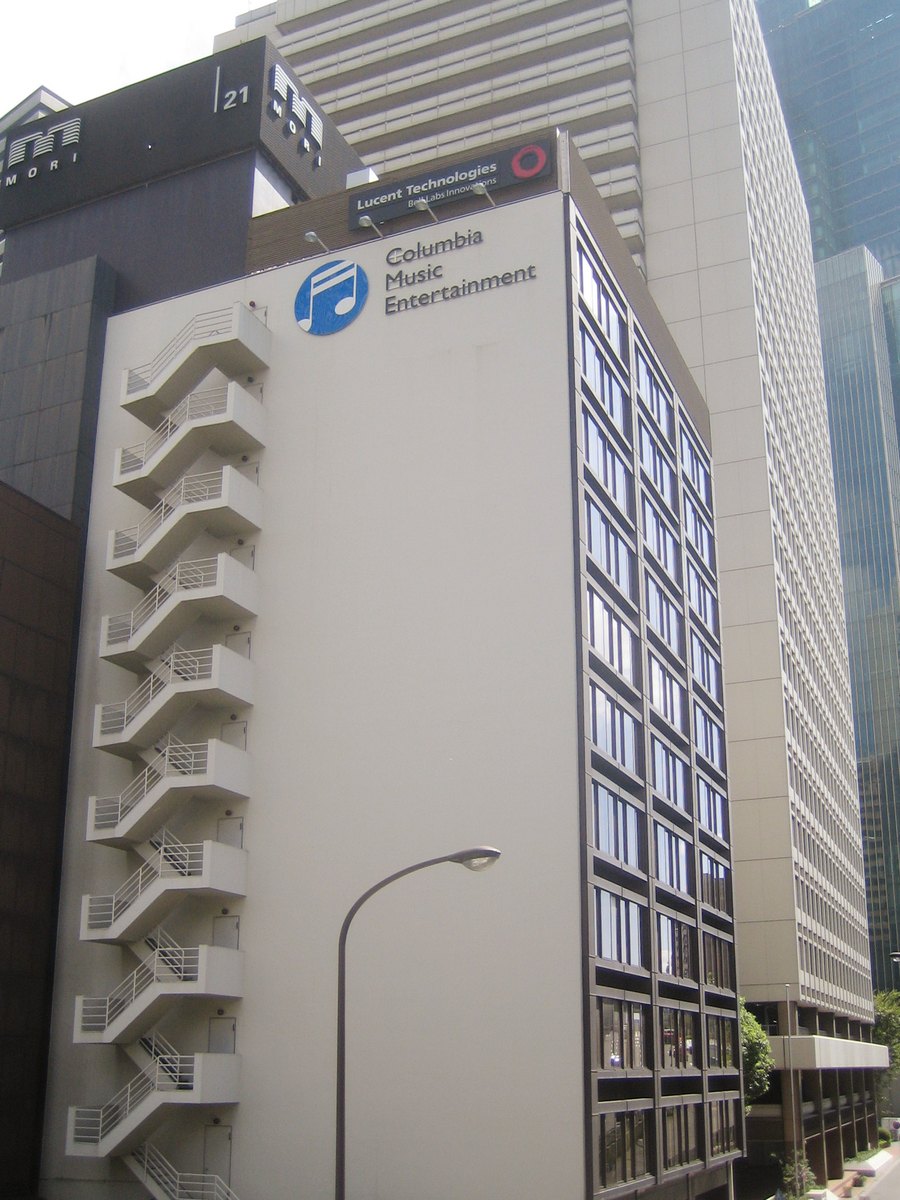
July 1, 2005 (Heisei 17) – Following the sale of its Akasaka headquarters building, the company moved its headquarters functions to the 21st Mori Building in Roppongi 1-chome, Minato, Tokyo.
2005 – The company sold its pressing division, Columbia Digital Media, retaining only the name.
September 28, 2007 (Heisei 19) – The company announced that it would acquire post-production company TDK Core, a subsidiary of TDK. The acquisition price was ¥1.5 billion, and TDK Core became a subsidiary on November 1 of the same year.
February 1, 2008 (Heisei 20) – TDK Core changed its name to Creative Core, now Azabu Lease.
August 24, 2009 (Heisei 21) – Due to the demolition and redevelopment of the 21st Mori Building, where its headquarters had been located, the company moved its headquarters to Edomisaka Mori Building, 4-1-40 Toranomon, Minato, Tokyo, at the request of landlord Mori Building.
January 2010 (Heisei 22) – The company split Creative Core and succeeded to all rights relating to the music, video, and educational software divisions that had existed since the former TDK Core era.
October 1, 2010 (Heisei 22) – The company marked its 100th anniversary. At the same time, it again changed its trade name to Nippon Columbia Co., Ltd. (third corporation).
March 28, 2011 (Heisei 23) – The company sold all shares in Creative Core to Wood Office Group.
October 1, 2012 (Heisei 24) – Through a company split, the company succeeded its sales businesses for music and video software, game-related software, and other products to its newly established subsidiary Columbia Marketing Co., Ltd.
October 1, 2013 (Heisei 25) – The company acquired the Omagatoki label and Sirius, a music copyright management company, from Shinseido.
March 26, 2014 (Heisei 26) – Faith, Inc. acquired a majority of the company’s shares through a tender offer and became its parent company.
April 1, 2014 (Heisei 26) – The company succeeded its distribution, special-sales, and mail-order businesses to Columbia Marketing Co., Ltd. through an absorption-type company split.
June 24, 2014 (Heisei 26) – To support Japan during the Japan–Colombia match in the group stage of the 2014 FIFA World Cup, the company changed its name to Japan vs. Colombia Co., Ltd. for the two days of June 24 and 25 only.
July 27, 2017 (Heisei 29) – The company was delisted, ending its 68-year history of listing on the First Section of the Tokyo Stock Exchange.
August 1, 2017 (Heisei 29) – The company became a wholly owned subsidiary of Faith through a share exchange.
February 1, 2021 (Reiwa 3) – The company moved its headquarters into Faith’s Tokyo office.
October 1, 2025 (Reiwa 7) – With the aim of making artificial intelligence-based businesses its core, the company established Nippon Columbia Group Co., Ltd. (にっぽんコロムビアグループ), operating in parallel with the existing company’s music business and Dreamusic’s music business.
April 1, 2026 – Relocated its headquarters to Jingumae M-SQUARE.
Sources
- Wikidata entity Q773717.
- en.wikipedia, Nippon Columbia (revision 1375895024), CC BY-SA 4.0.
- ja.wikipedia, 日本コロムビア (revision 110797235), CC BY-SA 4.0.
- Photograph: Nippon Columbia logo.svg on Wikimedia Commons, Public domain; a trademark of its owner - the organisation's own logo, by NIPPON COLUMBIA CO., LTD..
