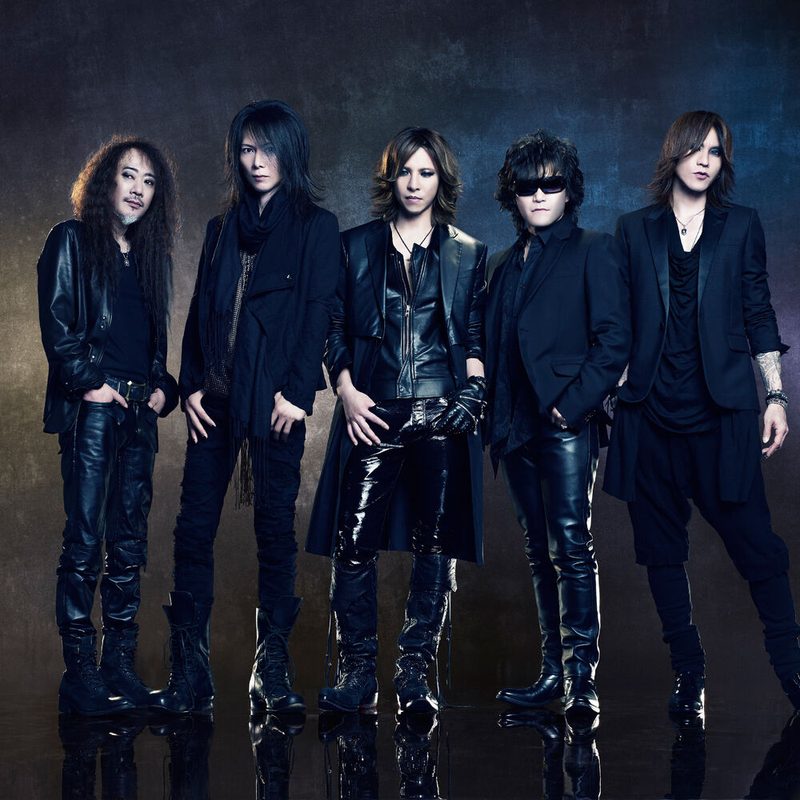
X Japan (Japanese: エックス・ジャパン, Hepburn: Ekkusu Japan) is a Japanese rock band from Chiba, formed in 1982 by drummer and pianist Yoshiki and lead vocalist Toshi. Starting as a predominantly power/speed metal band with heavy symphonic elements, they later gravitated towards a progressive sound with an emphasis on ballads. Besides being one of the first Japanese acts to achieve mainstream success while on an independent label, the group is widely credited as one of the pioneers of visual kei, a movement among Japanese musicians comparable to Western glam. Originally named X (エックス, Ekkusu), they released their debut album, Vanishing Vision (1988), on Yoshiki's own Extasy Records one year after finalizing their lineup including bassist Taiji, lead guitarist Hide and rhythm guitarist Pata. They achieved breakthrough success in 1989 with the release of their second and major-label debut album, Blue Blood. Following 1991's Jealousy, Taiji left the band in early 1992. He was replaced by Heath and the group changed their name to X Japan before producing the mini-album Art of Life (1993), which is composed solely of the 29-minute title track. In 1995 the group dropped most of its original visual kei aesthetics in favor of a more casual look and released Dahlia (1996), which like their two previous albums debuted at number one. X Japan performed their last concert at the Tokyo Dome on December 31, 1997, making it the last of five consecutive sold-out New Year's Eve concerts the group held at the stadium. After ten years, X Japan reunited in 2007 and recorded the new song "I.V.". Over the next two years they performed several concerts, including their first overseas show in Hong Kong, and formally added Sugizo as lead guitarist in place of Hide, who died in 1998, before holding a North American tour in 2010. In 2011, the band went on their first world tour throughout Europe, South America and Asia. Shortly after reuniting, work began on their sixth studio album. During its ten years of production, several release dates were announced, but it remains unreleased despite Yoshiki's claim of its completion in September 2018. The band has been inactive since that same year, and Heath died in 2023. X Japan has released five studio albums, six live albums, and 21 singles. In 2003, HMV Japan ranked the band at number 40 on their list of the 100 most important Japanese pop acts. In 2007, Rolling Stone Japan ranked Blue Blood number 15 on its list of the 100 Greatest Japanese Rock Albums of All Time. In 2017, Loudwire named X Japan the Best Metal Band from Japan. It has been reported that X Japan has sold over 30 million records.
Top Tracks
Releases in the Catalogue
- X Japan - Blue Blood Tour Bakuhatsu Sunzen GIG -
KSB5-5734(2001)
Members
Current
- Pata - Guitar
- Toshi - Lyrics By, Vocal, Vocals
- Yoshiki - Arranged By, Drums, Lyrics By, Music By, Piano
- Sugizo
Former
- Hide - Arranged By, Guitar, Music By
- Taiji - Bass
- Atsushi Tokuo
- Eddie Van Koide
- Hikaru Utaka
- Hiroshi Morie
- Hisashi Takai
- Isao Hori
- Kerry
- Satoru Murakami
- Tomoyuki Ogata
- Xenon
- Yoshifumi Yoshida
- Yuji Izumisawa
History
Translated from the ja.wikipedia article X JAPAN (CC BY-SA 4.0), revision 110657508.
Origin of the Band Name
Unable to come up with a good band name, the group temporarily named itself “X”. Afterward, YOSHIKI researched the meaning of the letter X and found that it could mean “many possibilities”, later defining it as representing “infinite possibilities” and freedom from being bound by genre. When expanding internationally, the band discovered that an American band with the same name already existed, and changed its name to X JAPAN in August 1992, alongside the announcement of HEATH’s joining.
Early Years
YOSHIKI and TOSHI, who had been childhood friends since kindergarten, were talking about the American hard rock band Kiss by the upper grades of elementary school and had promised to form a band together.
In their sixth year of elementary school, they formed DYNAMITE (ダイナマイト) (1977–1978), followed by NOISE (ノイズ) (1978–1982) after entering junior high school. They mainly performed cover songs by Led Zeppelin, UFO, and Rainbow, among others, and their first live performance was at their junior high school's farewell party for graduating students.
Afterward, because their junior high school was divided due to an increase in the number of students and its vocalist transferred to another junior high school, TOSHI, who had originally played guitar, became the vocalist.
1982–1988: Formation and Independent Era
The two continued their band activities after enrolling at the local Awa High School, but the other members left due to issues concerning further education. In the summer of 1982, X was formed during their second year of high school with the addition of members from other schools. At their high school cultural festival, they performed songs including “We are X” and the then-unfinished “I'LL KILL YOU”.
After graduating from high school, YOSHIKI had planned to take a recommendation-based entrance examination for a music university, but one week before the examination he abandoned further education and chose to pursue success as a rock band. In 1984, he moved the band's base of operations to Tokyo with TOSHI and founding member TERRY. Bassist ATSUSHI and guitarist TOMO also joined.
After moving to Tokyo, the two had no connections and searched for members and live music venues. By 1985, they had somehow managed to establish the band’s lineup. In June of that year, they released their first single, “I'LL KILL YOU”, through Dada Records. In 1986, YOSHIKI established his own label, Extasy Records (エクスタシーレコード), and released the second single, “Orgasm” (オルガスム). By this time, they had gained a certain level of established support, but the membership remained constantly fluid. This was often because members became disillusioned with YOSHIKI’s approach of practicing for more than ten hours a day, and the number of members who left exceeded 20, including those whose existence has not been confirmed. YOSHIKI was also seeking members who would not merely meet his difficult demands, but would advise him on his own policies, recognize one another’s individuality, and respect and help one another grow.
TAIJI, who had previously been a member of X for a time, rejoined the band at the end of 1986. PATA participated as a supporting musician in the recording of the omnibus album SKULL THRASH ZONE Vol.1, released by Victor in 1987. In early 1987, YOSHIKI persuaded HIDE, who had disbanded SAVER TIGER and decided to become a hairdresser, to join X. Following the departure of ISAO after he was involved in a traffic accident, PATA also became an official member, completing the lineup that would make X’s major-label debut.
At live music venues, the members staged performances such as behaving violently, breathing fire, and YOSHIKI pouring gasoline on cymbals and setting them alight, resulting in the band being banned from numerous venues. Problems also continued at post-concert parties, where fights were frequent and establishments were badly damaged. It was said that when rock musicians entered an izakaya, staff would check whether YOSHIKI was present. According to manga artist Masahiko Kikuni (喜国雅彦), who was familiar with the independent metal scene of the time, fights between musicians were so common at Shibuya izakayas that some establishments posted notices reading “No guitarists”, “No musicians”, and “No band members”; some even specifically displayed notices saying “No X”. Because of their unusual behavior, they became targets of criticism alongside HIDE-led SAVER TIGER and DEMENTIA, of which TAIJI had been a member, and were called one of the “three major bulky garbage bands of Kanto”. According to Shigeru Kosugi (小杉茂), then a member of DEMENTIA and now president and representative director of Howling Bull Entertainment, the term may have been coined by members of UNITED.
Believing that “no matter how good the songs are, there is no point if nobody listens to them,” X determined that they needed name recognition and appeared in the “Heavy Metal Corner” of Nippon Television’s Genius Takeshi’s Energizing TV!! (天才・たけしの元気が出るテレビ!!). They appeared in segments including the “Heavy Metal Sports Day”, in which participants competed while wearing their stage costumes, and “Early Morning Heavy Metal”, part of the program’s “Early Morning Series”, a well-known segment in which celebrities were awakened by loud noises from bazookas and similar devices after the crew entered their bedrooms while they slept. The program’s “Yashiro Shokudo Live” (やしろ食堂ライブ), in which they performed “Orgasm” in a small cafeteria, was HIDE’s first job after joining X. However, amid the prevailing attitude within the music industry at the time, particularly the rock scene, which sought to maintain its worldview with a serious image, television appearances outside music programs were regarded as taboo. As a result, industry figures and other bands branded X as troublemakers for having “turned heavy metal into comedy material”.
Following their television appearances, X’s name recognition spread nationwide. At a time when even the distribution of demo tapes was rare, they distributed VHS tapes containing original footage to customers. Ideas for other items to distribute included refrigerators, microwave ovens, and trucks. Because they promoted themselves more actively than other bands, they were regarded by other bands as a wealthy band.
In April 1988, X released its first album, Vanishing Vision. Within one week of its release, the initial pressing of 10,000 copies, an unusual figure at the time, had sold out. Although Vanishing Vision could have been released by a major label, YOSHIKI deliberately released it through Extasy Records, saying that X had “not yet left anything behind” as an independent band. At the same time, the band conducted contract negotiations with several major labels, leading to competition among record companies to sign X. The band ultimately signed with CBS/Sony. X signed with CBS/Sony because the directors from other companies involved in the negotiations had behaved with excessive arrogance. The members were angered by this, and YOSHIKI, who could handle negotiations calmly, was said to have taken charge of them. The fact that the offered conditions, including the signing fee and contract term, were the lowest also fostered a rebellious desire to “definitely succeed and show these people”, and was one factor in their decision to sign. CBS/Sony itself had not initially been enthusiastic in the negotiations, but Naoshi Tsuda (津田直士), who then belonged to the scouting and development division, was assigned to a new project team. Tsuda became the band’s director, persuaded both X and the company, and also took on management duties. At the same time, the private label exclusively for X, SIREN SONG, was established.
The origin of the X Jump, which later became a familiar feature of X’s concerts, was a performance at Forus Morning Moon in Sendai on July 19, 1988. During the band’s second encore, while performing “X”, guitarist HIDE suddenly jumped during the chorus and encouraged the audience to jump through gestures. Only a few fans responded at the time, but bassist TAIJI, who had watched HIDE from the stage, began jumping immediately afterward, followed somewhat later by PATA. However, because they were not yet accustomed to it, all three played out of tune each time they jumped.
On June 24, 1988, recording began for L.O.X as a spin-off project. L.O.X was a hardcore punk band formed by NAOKI of Lip Cream on guitar, ACT of ORANGE on bass, and YOSHIKI of X on drums, credited as Rei Shiratori (白鳥麗, REI).
1989–1993: Major Debut
On April 21, 1989, X made its major-label debut with its second album, Blue Blood, released through CBS/Sony/Siren Song. It debuted at number six on the Oricon chart. At a time when million-selling hits were rare in the music industry and even top-level rock bands considered sales of 100,000 copies a major hit, the album sold 600,000 copies in 1989 alone. Around June, the members stayed overseas to film music videos and write songs. In September of the same year, “Kurenai” was released as a single. Through active media exposure, including appearances on music programs, the band made a strong impact on many people who had never seen a visual kei band. Although X's excessive media exposure drew both praise and criticism from the music industry, the band appeared to be progressing smoothly until Yoshiki collapsed during a concert at Shibuya Kokaido (渋谷公会堂) on November 23 of that year, causing subsequent concerts to be postponed. Thereafter, Yoshiki continued his activities with the band while constantly carrying “time bombs” in his neck and arms. Despite this, X received numerous awards, including the New Artist Award at the Japan Cable Radio Awards and the Japan Gold Disc Award. Members of L.O.X, who were recording works during the same period, also took part in the recording sessions.
In February 1990, X resumed touring with its first concert at the Nippon Budokan, ending the tour with a concert at Osaka-jo Hall in May. In November, the band traveled to the United States to record its next album. While the members were absent, it held and successfully completed the film concert X Film Gigs: Covered in Blood and Roses.
On May 25, 1990, following approximately two and a half years of recording, L.O.X released its only album, Shake Hand.
While recording in Los Angeles, United States, Yoshiki developed a cervical disc herniation after recording the drums for the fast-paced song “Stab Me in the Back”, resulting in a substantial delay to the remaining recording schedule. As the record company set July 1991 as the release deadline, the band abandoned the recording of other fast-paced songs and “Art of Life”, among other material, and returned to Japan in June of that year. On July 1, it released its third album, Jealousy, which reached number one on the Oricon chart. The band held the Violence in Jealousy Tour 1991: Living Only in Dreams, and on August 23 gave its first concert at Tokyo Dome. Around the same time, it opened the limited-time “X Shop Jealousix” at Odakyu Mylord in Shinjuku, while Nissin Foods released “Cup Noodles X Flavor”; combined with its media exposure, X reached the height of its popularity during this period. On December 8, it held X with Orchestra at NHK Hall. At the tour final at the Budokan on December 20, the members appeared for a double encore during the FILM GIG and Yoshiki personally denied rumors of the band's breakup that had been reported in some newspapers around that time. On December 31, X appeared on the 42nd NHK Kōhaku Uta Gassen.
On January 5, 6, and 7, 1992, X held Towards Destruction, becoming the first Japanese artist to perform at Tokyo Dome for three consecutive days and drawing a total audience of 120,000. Immediately afterwards, Taiji left the band, citing “differences in musical and fashion direction”. The announcement was formally made by Toshi through a video message on the January 31 broadcast of Music Station. However, this was in fact a dismissal, and Taiji later revealed in his book that “Yoshiki directly pressured [him] to leave the band.” He stated that Yoshiki may have become exhausted with Taiji taking on the unpopular role within the band, such as demanding higher fees; that some staff members may have influenced Yoshiki; and that friction may have arisen between them after Taiji began openly criticizing Yoshiki's drumming. Yoshiki, meanwhile, stated in his autobiography YOSHIKI/Karuki that although Taiji's bass was necessary for X, Taiji had “very easily broken promises” between the two. It was also said that, even before his departure, Taiji was no longer an official member and was under contract as a studio musician.
X's contract with Sony ended on April 20, 1992. At a Sony executive meeting held in mid-May, voices were heard saying that “Yoshiki's selfishness cannot be stopped.” One factor was Yoshiki's unwillingness to compromise in recording, as well as the belief that, because Sony fully handled management and distribution, “for an artist and record company to deal with each other on equal terms, the management office must be independent.” Yoshiki himself had been preparing for independence since 1991. On August 24, 1992, X held a press conference at Rockefeller Center in New York, announcing that it had signed with the American company Time Warner in order to expand internationally and that Heath had joined as its new bassist. Its works would be released through the Atlantic label overseas and Warner Music Japan in Japan. However, because a Los Angeles band also named X had already become internationally famous through “Wild Thing” from the film Major League, X changed its name to X Japan. Initially, the band called itself X from Japan, but soon changed this. It also continued activities in Japan, including an appearance at Music Station Super Live '93 at Tokyo Bay NK Hall on December 24, 1993.
1994–1996: Prolonged Recording
The first project undertaken after signing with Warner Music Japan was the recording of "Art of Life", which had not been included on Jealousy. Although a demo tape had already been completed by the summer of 1990, recording TOSHI's vocals proved difficult. In addition, following bassist TAIJI's departure, the completed bass line was re-recorded with HEATH's bass line. It was finally released in August 1993.
At the same time, the members' solo activities became increasingly active. However, as scheduling conflicts with X JAPAN gradually arose, YOSHIKI, who also managed X JAPAN's recording schedule, grew increasingly distrustful of the other members. Nevertheless, recording for X JAPAN's new album continued to progress slowly.
Originally, the album following Jealousy had been planned as an album for international expansion. The band was simultaneously producing two works, one for Japan and one for overseas markets, and was recording English-lyric versions of past songs. However, due to issues with TOSHI's English pronunciation and the growing prominence of grunge acts such as Nirvana in the rock scene, YOSHIKI decided that “X would not sell if released now,” and the overseas expansion was abandoned.
The prolonged recording also worsened relations with Warner Music Japan. Bank loans secured by unfinished master tapes became difficult to obtain, and YOSHIKI sold his Ferrari to raise production funds and continue recording. As four years of album recording after the contract had made expenses excessive, completed songs were released one after another as singles as a desperate measure to sustain the recording work. Furthermore, because B-sides could not be prepared, the singles were filled out with previously unreleased live recordings.
As X JAPAN's popularity grew both in Japan and abroad, the band partnered with Mugen Motorsports and became the sponsor of racer Katsumi Yamamoto, who led the team X JAPAN Racing in Formula Nippon in 1995. In the 1996 season, it sponsored Ralf Schumacher; both Schumacher and the team achieved victory.
Due to his chronic cervical disc herniation, YOSHIKI abandoned the recording of several high-speed songs.
In November 1995, before even the title track "Dahlia" had been released, let alone the new album, the nationwide Dahlia Tour 1995–1996 began. In consideration of YOSHIKI's health, the schedule generally consisted of two days at one venue every one to two weeks. However, on March 13, 1996, during the first day of the Nagoya performance, YOSHIKI suffered a recurrence of his disc herniation during the concert. All subsequent tour dates were canceled, effectively ending the tour. Of the 18 performances, excluding the postponed Fukuoka date, seven were canceled. The rescheduled Fukuoka Dome performance was also canceled.
After the lengthy recording process, the final original album, Dahlia, was finally released on November 4, 1996. Although it became a major hit and reached number one on Oricon, six of its ten songs had already been released as singles before the album's release despite the five years and four months spent on it; "Scars" was also released as a single after Dahlia. The album thus became similar to a greatest-hits album. From around this time, TOSHI stated that he had begun to feel stifled by X JAPAN's existence and activities.
In December 1996, X JAPAN held Dahlia Tour Final, the final concert of the Dahlia Tour 1995–1996, at Tokyo Dome.
1997–2006: Disbandment, HIDE's Death, and X JAPAN After Disbandment
In April 1997, TOSHI left the band, citing differences in musical style and direction. However, as a replacement vocalist for TOSHI could not be found, X JAPAN held a press conference on September 22 to announce its disbandment. HIDE then persuaded YOSHIKI that the band should perform live as a form of closure for its fans. With TOSHI also participating, X JAPAN appeared on TV Asahi's 500th Anniversary Music Station Special Super Live '97 on December 26, 1997, held its final concert, THE LAST LIVE: The Last Night, at Tokyo Dome on December 31, 1997, and concluded with an appearance on the stage of the 48th NHK Kōhaku Uta Gassen after the concert.
The remaining members planned to reunite in 2000 with a new vocalist, while each member pursued solo activities in the meantime. HIDE in particular began working actively under the name hide with Spread Beaver. However, HIDE died suddenly on May 2, 1998. This was followed by the release of live albums and live DVDs, including Art of Life Live and THE LAST LIVE: The Last Night, the fan-voted compilation album X JAPAN BEST: FAN'S SELECTION, and the holding of FILM GIG events in major cities throughout Japan and in Seoul, South Korea.
Then-Prime Minister Junichiro Koizumi, who was from the same hometown as HIDE and had also been involved in the construction of the hide MUSEUM, attracted attention by publicly declaring himself to be an “X JAPAN fan,” while “Forever Love” was used in commercials during national elections by the Liberal Democratic Party. At the same time, however, many reports emerged that worried former fans, including controversy over allegations that TOSHI had been brainwashed and YOSHIKI's lack of direction. YOSHIKI in particular almost completely ceased public musical activities in Japan and pursued projects in the United States centered on Violet UK. He later stated that this was because HIDE's death had caused him severe psychological damage, as the two had shared a deeply trusting relationship in both their public and private lives.
In 2002, YOSHIKI appeared as a guest on NHK's Watashi wa Akiramenai and, speaking about TOSHI, whose departure had been the direct cause of the disbandment, said that he had treated “TOSHI's voice like a tool,” acknowledging that there had been problems with his own conduct. He stated that a turning point after HIDE's death had been the cheers from fans that he received when performing the celebratory song “Anniversary” at the National Celebration for the Tenth Anniversary of the Emperor's Accession to the Throne. Footage of this was later supplemented with unaired material and compiled in a program book. At the time, however, TOSHI did not accept this, saying, “I do not watch television, so I do not know.”
In South Korea, “Tears” was used as an insert song in the film Windstruck, making it the first Japanese-language song used in a South Korean film after the lifting of restrictions on Japanese culture. In Europe, bands covering X JAPAN songs also emerged. At the reunion announcement mentioned below, media outlets widely reported on fans who had rushed to Tokyo from across Asia, as well as young people who had not known X JAPAN during its active years.
2007: Reunion
On February 10, 2007, TOSHI stated on his website that the president of X JAPAN's former management agency had repeatedly attended his live venues and asked him, “The other members want to reunite; what do you think, TOSHI?” Initially negative about a reunion, TOSHI had continued to refuse firmly, but because the president came so many times, he also confirmed the matter with YOSHIKI. He revealed that discussions were moving forward with the support and expectations of their mutual friend Tetsuya Komuro. On March 21 of the same year, TOSHI disclosed on his website that he had visited YOSHIKI's studio in Los Angeles and performed with him for the first time in approximately ten years. He also revealed that the song they had played in the session was “Without You,” which YOSHIKI had composed as a tribute to HIDE and included on his 2005 classical album Eternal Melody II, and hinted that a project with YOSHIKI and the release of new songs were in progress. In June of that year, YOSHIKI acknowledged in an interview with Sponichi that discussions toward a reunion were underway.
On October 18, the resumption of activities was officially announced on the group's official website. It was reported that an open filming of the promotional video for the new song “I.V.” would be held on October 22 on the rooftop of Aqua City Odaiba in Daiba, Minato, Tokyo. During the filming, a doll of HIDE held in YOSHIKI's arms was also present, and the five members of X JAPAN appeared before fans gathered in Daiba for the first time in ten years. In the music video, a microphone stand and guitar were placed in HIDE's stage position, conveying the meaning that “HIDE will be taken to the world as well.” Following the filming, it was also revealed that reunion concerts in Tokyo were planned for around spring 2008. “I.V.” was produced as a song by all five members of X JAPAN, including digitally processed guitar sounds by the late HIDE, and was released on January 23, 2008. It was used as the main theme song for the Hollywood film Saw IV. The filmed music video was included in the X JAPAN Returns Complete Edition DVD-BOX, released on February 29, 2008.
In a later television interview, YOSHIKI said that the reunion was intended to bring X JAPAN to a proper close, and that the group would not remain active for a long period. Regarding HIDE's successor as guitarist, he stated that the guitarist would take the form of a guest, that HIDE's position would be left vacant, and that X JAPAN would always be with HIDE. He also stated that it was impossible to newly record HIDE's guitar parts and that his conflict with TOSHI had not been completely resolved. At a solo concert following the revival, TOSHI said, “I want to continue making healing music while also doing X JAPAN.”
2008: International Expansion
A press conference was held at the Apple Store in Shibuya on January 20, 2008, where it was announced that two reunion concerts would be held at Tokyo Dome on March 28 and 30 of that year. That evening, a talk event was held at Tower Records Shibuya with the members of X Japan and 160 invited fans. Advance reservations began on the day of the press conference, but due to greater-than-expected demand, it was announced that the original plan would be changed to open rear seats in the dome and increase capacity, as well as to hold additional concerts from the summer onward. It was also stated that a Europe, United States, and Asia tour, X Japan's first overseas performances, would be announced within the year. The reunion concerts were titled X Japan Attack Resumes 2008 I.V. ~Towards Destruction~, with March 28 named “Night of Destruction” and March 30 named “Night of Creation”. It was later decided to hold an additional concert on March 29, which had originally been left open for rest by members including Yoshiki, as it was judged that the response to the reunion concerts was too great for sufficient capacity to be secured over only two days. March 29 was named “Reckless Night”, with Yoshiki declaring that he was “prepared to risk his life”. The cancellation of an auction for premium seats was also announced due to concerns over rising ticket prices. It was again emphasized that the concert would be performed by “the five-member X Japan”, with the stage arrangement remaining “the same configuration as when HIDE was there”; during the reunion concerts, HIDE was displayed on the stage and monitors through special images, including holograms. At this press conference, the simultaneous release of “I.V.” in 23 countries worldwide through the iTunes Store and other services was announced.
HIDE's memorial concert, hide memorial summit, was held on May 3–4, 2008, featuring LUNA SEA, T.M.Revolution, Dir en grey, Maximum the Hormone, and others. X Japan appeared on the second day, performing “Without You”, HIDE's solo song “Pink Spider”, and other songs, as well as performing LUNA SEA's “BELIEVE” with members of LUNA SEA. On December 31, it held the countdown concert X Japan Countdown Gig ~Returning to Our Roots~ at Akasaka BLITZ. The event was broadcast exclusively live via CS broadcasting and DMM.com, and was also screened live at 13 TOHO Cinemas locations nationwide.
Yoshiki later suggested through magazine interviews and Myspace that a Japanese-language version of “I.V.” would be released and that new songs, including “Without You”, were being produced. He stated, “Perhaps we may be able to continue our activities longer than originally envisioned.”
Tours in Paris, the United States, and elsewhere were planned that year, but were canceled due to Yoshiki's poor health. A Christmas concert in Japan was also planned, but was canceled.
2012–2017: Advance Into the World
On April 11, 2012 (April 12 Japan time), X Japan became the first Asian band to be nominated for the Best International Band Award at the 4th Golden Gods Awards, the largest hard rock/heavy metal event in the United States, and won the award. The band also announced that production of its world debut album had entered its final stages and that a second world tour was being planned.
On May 20, 2013, X Japan held a press conference at the unveiling ceremony for life-size X Japan figures at Madame Tussauds Tokyo, a facility within Decks Tokyo Beach in Tokyo. The band expressed its determination to hold its second world tour in 2014. It was its first press conference in 21 months. The band stated that it planned to release an album that would serve as its “calling card to the world”.
On April 29, 2014, at the Costa Mesa performance of Yoshiki's solo world tour, Yoshiki Classical World Tour, it was announced that X Japan would perform at Madison Square Garden for the first time on October 11, and that The World: X Japan's First Global Best would be released worldwide on June 17. During the concert, Yoshiki performed mainly on piano, playing X songs and “Anniversary”, among others, with a female string ensemble. Toshl also participated as a guest, and the performance was well received.
On August 17, 2014, X Japan held its first guerrilla live performance in Japan at Shinjuku Station Square in Tokyo. The band performed the X Japan version of “Hero”, the theme song for Saint Seiya: Legend of Sanctuary, released on June 21 that year, and also filmed a music video. It was the first domestic music video shoot in approximately seven years, since “I.V.” in 2007, and the first since Sugizo joined the band.
On September 30 and October 1, 2014, X Japan held solo concerts at Yokohama Arena, its first one-man live performances in Japan in four years since its 2010 Nissan Stadium concerts. The 22,000 platinum tickets prepared for the two days sold out in one second. The Yokohama Arena concerts also attracted attention as X Japan's first performances at the venue in 23 years, since the Violence in Jealousy Tour in 1991.
On October 12, 2014, X Japan held a concert at Madison Square Garden in New York City, United States, also known as “the world's most famous arena”. The venue drew 15,000 fans, setting a record for an Asian artist performing alone.
2018–: YOSHIKI's Return to Drums, De Facto Hiatus, and the Death of HEATH
On April 10 and 11, 2018, “X JAPAN 10th Anniversary of Revival: X JAPAN LIVE 2018, PREMIUM GIGS Immediately Before Appearing at an American Festival ~YOSHIKI”
Musical Style and Influences
X Japan's musical style was influenced by American and British glam metal and heavy metal. While incorporating symphonic elements, it is characterized by energetic speed metal/power metal-style songs, with “Kurenai” and “Silent Jealousy” being notable examples, as well as emotionally rich ballads such as “Endless Rain” and “Forever Love”. Many of the band's songs use orchestral passages, a tendency particularly evident in longer tracks such as “Tears”, “Crucify My Love”, and “Art of Life”.
YOSHIKI composed most of the band's works, while comparatively few were composed by the other members. hide composed several songs, including “Scars”, while PATA composed only a small number, including “White Wind from Mr. Martin ~Pata's Nap~”. TAIJI composed several songs, including “Voiceless Screaming” and “Desperate Angel”, which are included on the album Jealousy. In 2010, it was reported that SUGIZO had written several songs, but no further information has emerged since then. At the time, YOSHIKI said of X Japan's new material, “It is almost the same as before. It may be a little edgier.” However, in 2014, he stated that the next work would be very heavy while also melodic, with a “more modern” sound, and would be different from previous works.
YOSHIKI's compositional process is distinctive in that, before entering the studio with the band, he writes sheet music for every instrument, including guitar and drums. Naturally, changes are made when necessary. For example, by the time “Dahlia” was produced, 80% to 90% of the guitar parts had been composed by HIDE.
In order to bring the songs closer to their intended image, YOSHIKI approached recording like a film screenwriter and director, exploring how to inspire or deceive Toshl into producing the vocal performance he wanted. For each song, he had the vocals recorded on seven to ten tracks, which were stored as material in a computer. From these recordings, YOSHIKI selected the best takes and edited them into the finished work. He would spend an hour and a half on a single line; if there were 60 lines, he would spend as much as 100 hours combining them, so that Toshl would be pleased by a sense of accomplishment. However, this also led him to regret that he had “mercilessly overworked Toshl like a tool every day.”
Influences
YOSHIKI, the band's principal songwriter, has cited Iron Maiden's The Number of the Beast and Killers as favorite albums, stating that he particularly liked their punk rock elements. He also reportedly enjoyed and frequently listened to the Sex Pistols, the Clash, G.B.H., and Chaos UK.
Influence
Many bands and artists, particularly hard rock and heavy metal bands and visual kei artists who debuted from the late 1990s onward, have stated that they were influenced by X Japan. These include MIYAVI, DIR EN GREY, SYU and Fumiya of GALNERYUS, the GazettE, D, Mao (真緒), the vocalist of Sadie, Toru Kawauchi (川内亨) of 12012, Maya of LM.C, FLOW, Yuuki of Unsraw, DJ OZMA, Kei of Dio – Distraught Overlord, aie of deadman, Jin of Screw, and DaizyStripper. The members of Versailles have publicly stated that they were influenced by X and LUNA SEA. In particular, vocalist KAMIJO stated, “I do not think there is anyone in the Japanese music industry who has not been influenced by X JAPAN.” Leda, who has performed with GALNERYUS and DELUHI, also stated that he would not even have become interested in music if a friend had not played him songs by X JAPAN and LUNA SEA, and described X JAPAN as his “bible.” Marty Friedman has praised X JAPAN as the biggest band in the visual kei scene and as “outstandingly versatile musically,” and stated that listening to X JAPAN drew him into Japanese rock. X JAPAN also had a major influence on the metal dance unit BABYMETAL, which debuted after 2010; YOSHIKI has at times commented on the homages to X JAPAN found in their songs and stage performances.
Their influence extended beyond popular music, providing the impetus for Daisuke Ehara (江原大介), a composer of wind band works, and Yuta Miyake (三宅悠太), a composer of choral music, to become composers.
Current Members
The following members constitute the "current lineup" on the official website's "BIOGRAPHY" page, with their listed roles also following that page. For their principal careers and individual activities, see their respective articles.
YOSHIKI (ヨシキ): Drums, Piano, Composer (1982–1997, 2007–present) Toshl (トシ): Vocal (1982–1997, 2007–present) PATA (パタ): Guitar (1987–1997, 2007–present) HEATH (ヒース): Bass (1992–1997, 2007–2023); died in 2023 SUGIZO (スギゾー): Guitar & Violin (2008–2009 as a support member, 2009–present)
Former Members
HIDE (ヒデ): guitar (1987–1997); died in 1998.
TAIJI (タイジ): bass (1985, 1986–1992); died in 2011.
TERRY (テリー) / YUJI (ユウジ): guitar (1982–1985). He was a high school classmate of YOSHIKI and Toshl. He left as a condition of TAIJI joining the band. After his departure, he was encouraged to rejoin but declined. He died in a traffic accident in 2002.
TOMO (トモ): guitar (1984–1985). He left after the release of the first single, “I'LL KILL YOU”.
ATSUSHI (アツシ) / TOKUO (トクオウ): bass (1984–1985). He was a senior of YOSHIKI and Toshl in high school. He is currently recuperating from illness.
EDDIE (エディー): guitar (1985). A former member of THE WRETCHED and CRACKED BRAIN, and a member of RITUAL CARNAGE. He joined as TOMO's replacement and left together with TERRY.
HALLY (ハリー): guitar (1985). A former member of DEMENTIA and a member of UNITED. He was the guitarist whom TAIJI brought with him when he first joined. He replaced TERRY. According to Yoshida, he was only in X for about half a month and did not even perform live with the band.
JUN (ジュン) / SHU (シュウ): guitar (1985, 1986). He joined as HALLY's replacement, then left, before rejoining as ZEN's replacement. After leaving, he formed Rommel with HIKARU.
ZEN (ゼン) / Xenon: guitar (1985–1986).
HIKARU (ヒカル): bass (1985–1986). A former member of MEPHISTOPHELES, he joined as TAIJI's replacement but left together with JUN. TAIJI subsequently rejoined.
SATORU (サトル): guitar (1986). After leaving X, he joined Virus.
ISAO (イサオ): guitar (1987). He left following a motorcycle accident. PATA, who had previously been a temporary guitarist, later joined as an official member.
Support Members
KERRY (ケリー): Guitar (1986) A member of BADWILDE and a former member of Mein Kampf and Jail Bait.
HIBARI (ヒバリ): Drums (1989) The drummer of PRESENCE. He participated in place of YOSHIKI in “ENFENT TERRIBLE: The Terrible Children”, held on December 3, 1989.
The Five Great Majin
The Five Great Majin (大魔神五人組, Daimajin Gonin Gumi) was X's part-switching band, performed live as a fan service during the period when the group was still known as X. Every member played a different instrument from their usual role. At their final performance, at Towards Destruction, YOSHIKI was also assigned guitar, but he merely ran around the stage holding a guitar; in practice, TAIJI was the only guitarist at that time.
Vocals: HIDE (Robo) Drums: TOSHI (Ocharu-chan) Guitar: TAIJI (Himalayan Goro) Guitar: YOSHIKI (John) Bass: PATA (Secretary-General Gonzalez)
Sources
- Wikidata entity Q179767.
- en.wikipedia, X Japan (revision 1367575636), CC BY-SA 4.0.
- ja.wikipedia, X JAPAN (revision 110657508), CC BY-SA 4.0.
- Photograph: X Japan.jpg - Press shot via Deezer (artist 969).